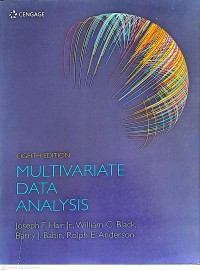
Text
Multivariate Data Analysis
In more than four decades since the first edition of Multivariate Data Analysis, the fields of multivariate statistics,
and analytics in general, have evolved dramatically in several different directions for both academic and applied
researchers. In the methodological domain, we have seen a continued evolution of the more “traditional” statistical
methods such as multiple regression, ANOVA/MANOVA and exploratory factor analysis. These methods have
been extended not only in their capabilities (e.g., additional options for variable selection, measures of variable
importance, etc.), but also in their application (e.g., multi-level models and causal inference techniques). These
“traditional” methods have been augmented by a new generation of techniques represented by structural equation
modeling and partial least squares. These methods integrate many of the former methods (e.g., multiple regres-
sion and exploratory factor analysis) into new analytical techniques to perform confirmatory factor analysis and
structural model estimation. But perhaps most exciting has been the integration of methods from the fields of data
mining, machine learning and neural networks. These fields of study have remained separate for too long, repre-
senting different “cultures” in terms of approaches to data analysis. But as we discuss in Chapter 1 and throughout
the text, these two fields provide complementary approaches, each of which has advantages and disadvantages. We
hope that by acknowledging these complementarities we can in some small way increase the rate of integration
between the two fields.
The development of these analytical methods has also been greatly facilitated by the tremendous increase in
computing power available in so many formats and platforms. Today the processing power is essentially unlim-
ited as larger and larger types of problems are being tackled. The availability of these techniques has also been
expanded not only through the continued development of the traditional software packages such as SAS and it’s
counterpart JMP, IBM SPSS and STATA, as well as SmartPLS for PLS-SEM, but also the recent wide-spread use of
free, open-source, software, typified by the R-project, which has been around as far back as 1992, with roots at Bell
Labs previous to that time. Today researchers have at their disposal the widest range of software alternatives ever
available.
But perhaps the most interesting and exciting development has occurred in the past decade with the emergence
of “Big Data” and the acceptance of data-driven decisionmaking. Big Data has revolutionized the type and scope of
analyses that are now being performed into topics and areas never before imagined. The widespread availability of
both consumer-level, firm-level and event-level data has empowered researchers in both the academic and applied
domains to address questions that only a few short years ago were not even conceptualized. An accompanying trend
has been the acceptance of analytical approaches to decisionmaking at all levels. In some instances researchers had
little choice since the speed and scope of the activities (e.g., many digital and ecommerce decisions) required an
automated solution. But in other areas the widespread availability of heretofore unavailable data sources and unlim-
ited processing capacity quickly made the analytical option the first choice.
The first seven editions of this text and this latest edition have all attempted to reflect these changes within the
analytics landscape. As with our prior editions we still focus in the traditional statistical methods with an emphasis
on design, estimation and interpretation. We continually strive to reduce our reliance on statistical notation and
terminology and instead to identify the fundamental concepts which affect application of these techniques and then
express them in simple terms—the result being an applications-oriented introduction to multivariate analysis for
the non-statistician. Our commitment remains to provide a firm understanding of the statistical and managerial
principles underlying multivariate analysis so as to develop a “comfort zone” not only for the statistical but also the
practical issues involved
Ketersediaan
Informasi Detail
- Judul Seri
-
-
- No. Panggil
-
519.535 HAI m
- Penerbit
- Androver, Hampsire United King : Cengage Learning., 2019
- Deskripsi Fisik
-
xvii, 813 hal. : ilus ; 27.8 cm
- Bahasa
-
Arab
- ISBN/ISSN
-
978-1-4737-5654-0
- Klasifikasi
-
519.535
- Tipe Isi
-
text
- Tipe Media
-
-
- Tipe Pembawa
-
-
- Edisi
-
Edisi 8
- Subjek
- Info Detail Spesifik
-
Index hal 800 - 813
- Pernyataan Tanggungjawab
-
-
Versi lain/terkait
Tidak tersedia versi lain
Lampiran Berkas
Komentar
Anda harus masuk sebelum memberikan komentar
 Karya Umum
  Filsafat
  Agama
Agama  Ilmu-ilmu Sosial
  Bahasa
  Ilmu-ilmu Murni
  Ilmu-ilmu Terapan
  Kesenian, Hiburan, dan Olahraga
  Kesusastraan
  Geografi dan Sejarah